The Consequences of Hiring an Unlicensed Drone Pilot In the Virgin Islands

Drone Laws in the Virgin Islands: USVI vs BVI — What Every Operator and Business Must Know
The Virgin Islands are a dreamscape from the air: turquoise bays, coral-lined coves, lush peaks, and yacht-dotted anchorages. Drones let us capture all of it — but the same waters that separate St. Thomas from Tortola also separate two legal worlds. The U.S. Virgin Islands (USVI) follow U.S. Federal Aviation Administration (FAA) rules, while the British Virgin Islands (BVI) follow Air Safety Support International (ASSI) guidance under the UK Civil Aviation Authority.
If you’re a realtor, property manager or yacht crew wanting to operate your drone for anything other than personal use, becoming educated on the local drone operation laws isn’t optional. It’s the difference between trusted, scalable content and fines, confiscations, and brand damage. This guide explains the essentials, compares USVI vs BVI rules, and shows how to turn compliance into a marketing advantage. Pilot Institute+2Drone Laws+2
Part 1 — USVI Drone Laws (FAA) & Real-World Risks
1) The U.S. Framework in a Nutshell: Part 107 vs Recreational Exception
USVI airspace is U.S. airspace. For any non-recreational use (marketing a villa, showcasing a yacht, filming an event, inspections, etc.), you need an FAA Part 107 Remote Pilot Certificate. Purely recreational flyers fall under 49 U.S.C. §44809 — but the moment there’s a business purpose or benefit, you’re in Part 107 territory. Pilot Institute+1
Key point: “Commercial” is broader than “paid.” If you post drone footage to promote your own listing or brand, that’s a non-recreational flight requiring Part 107. Pilot Institute
2) Core FAA Rules That Apply in the USVI
Whether flying under Part 107 or the recreational exception, the following are foundational:
Visual Line of Sight (VLOS): You (or a designated visual observer) must see the aircraft at all times. Pilot Institute
Altitude Limit: 400 ft AGL (with narrow exceptions around tall structures). Penalties for flying above limits can be harsh without approvals/waivers. Pilot Institute
Controlled Airspace Authorization: Near airports (e.g., Cyril E. King on STT), you need prior authorization (LAANC/DroneZone) or a waiver for operations that exceed standard limits. Pilot Institute
No-Fly Zones / TFRs: Always check for restricted areas and temporary flight restrictions. They can appear quickly and change often. Pilot Institute
Remote ID: Most drones must broadcast ID/location — think of it like a digital license plate. Pilot Institute
Local/Property Rules: FAA compliance doesn’t override trespass, privacy, or municipal restrictions; get property permissions where appropriate. Pilot Institute+1
3) Consequences of Unlicensed or Unsafe Flying
The FAA has escalated enforcement using Remote ID data and public evidence. Risks include:
Civil & Criminal Penalties: Failure to register an unmanned aircraft that is required to be registered may result in regulatory and criminal penalties. The FAA may assess civil penalties up to $27,500. Criminal penalties include fines of up to $250,000 and/or imprisonment for up to three years. FAA
The FAA cites fines up to $75,000 per violation for unsafe/unauthorized operations; egregious cases can include criminal exposure. Pilot Institute
Seizure, Bans, and Waiver Revocations: Notorious cases have ended with equipment confiscation and long-term or permanent bans from flying. Pilot Institute
Insurance Problems: Illegal operations often void liability coverage — a major risk if there’s property damage or injury. Pilot Institute
Reputational Damage: Brands hiring unlicensed pilots can be named and shamed — and lose bookings in a trust-driven tourism economy. MEDIABOOST.VI
4) Why Hiring a Licensed Pilot Protects Your Brand
From a business standpoint, licensed (Part 107) and insured pilots reduce operational and reputational risk:
Compliance Assured: Certifications, authorizations, and waivers handled correctly.
Safety Culture: Trained pilots understand weather, airspace classes, crew roles, and emergency procedures.
Continuity: No surprise shutdowns due to enforcement or equipment seizure.
Marketing Trust: You can confidently say your assets were captured legally — a crucial differentiator for resorts, villas, and charters. MEDIABOOST.VI
Part 2 — BVI Drone Laws (ASSI/UK) & What Visitors Must Know
1) Who Regulates BVI Airspace?
The British Virgin Islands are a UK Overseas Territory. Drone rules are set and overseen by Air Safety Support International (ASSI), operating under the UK CAA. The framework is similar to UK small unmanned aircraft rules but tailored to Overseas Territories. Drone Laws
2) Hobbyist / Recreational Operations in the BVI
Recreational flying is allowed, with notable conditions:
Registration: Required for drones over 250 g or equipped with a camera.
Pilot License: Not typically required for basic hobby flying.
Altitude & VLOS: 400 ft AGL max and maintain visual line of sight.
People/Property: Keep safe separation; don’t overfly private property or uninvolved persons without permission.
Night/BVLOS: Special permission and lighting/mitigations required.
Insurance: Not legally mandated for hobbyists but strongly recommended.
3) Commercial/Aerial Work in the BVI
Professional work (media, real estate, inspections, events) is more stringent:
Certification/Authorization: Commercial pilots need recognized authorization and must follow ASSI’s operational requirements.
Drone Registration: Required.
Insurance: Mandatory for commercial ops.
Operational Permission: Often needed for proximity to people/structures, specific sites, or sensitive zones.
Operations Manual: Risk assessments, mitigations, privacy protections, and emergency procedures are expected.
Night & BVLOS: Only by explicit approval with adequate lighting and redundancy. Drone Laws
4) Visitors & Foreign Operators
Non-resident pilots bringing drones into the BVI must comply like locals:
Register equipment, carry certification, show insurance.
Apply for operational permission with details on aircraft, flight areas, and safety mitigations.
Do not assume your U.S. approvals transfer — they don’t. Drone Laws
5) Enforcement & Exposure
While enforcement in some Overseas Territories can seem lighter than in the U.S., penalties and confiscation are possible — and civil liability for privacy/damage is very real. For brands that depend on trust, the reputational hit can be far worse than a fine. Drone Laws
Part 3 — USVI vs BVI: Side-by-Side
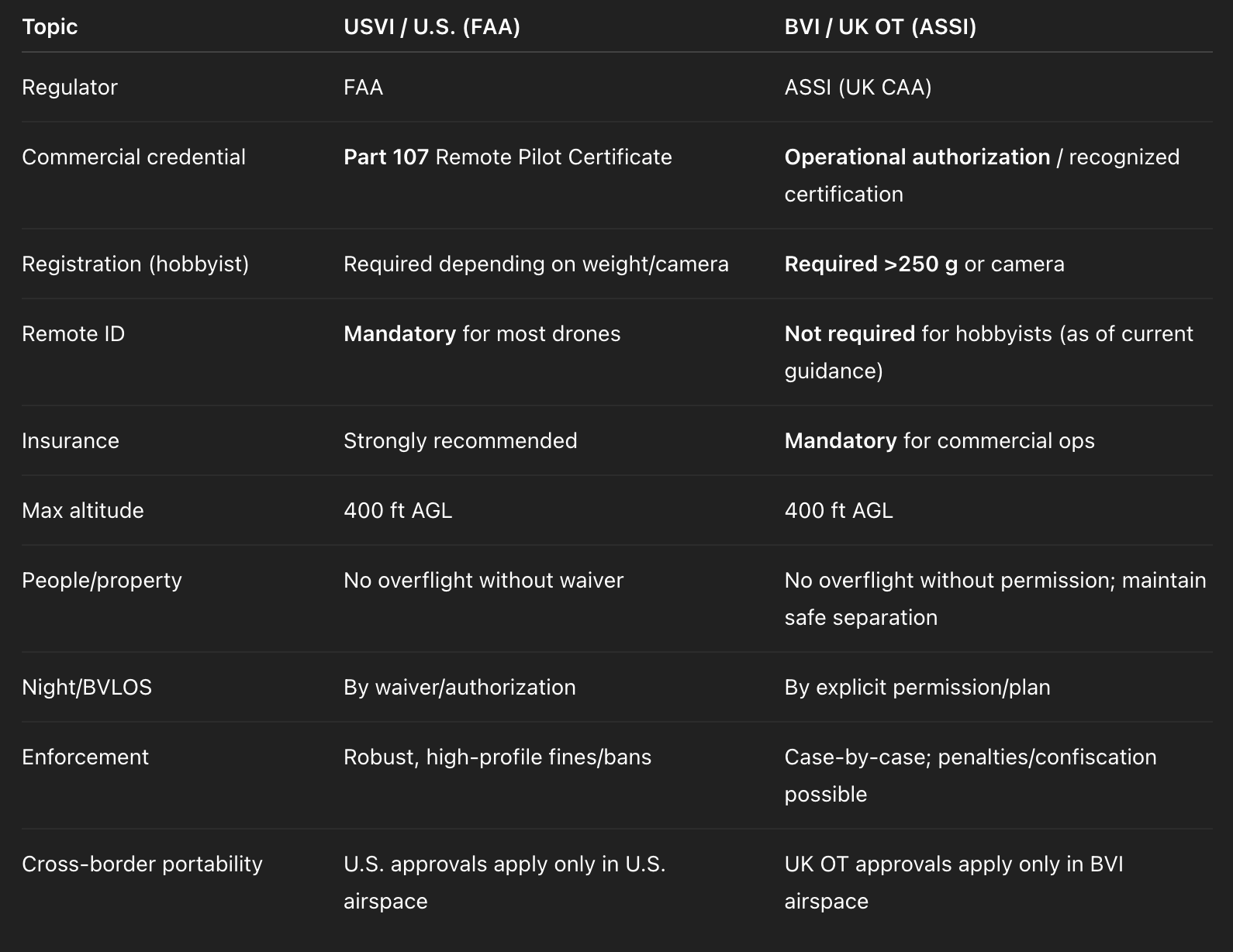
Sources: FAA/Part 107 overview & penalties; ASSI/Overseas Territories guidance and BVI summary. Pilot Institute+2Pilot Institute+2
Part 4 — Cross-Border Playbook (For Shoots Spanning USVI & BVI)
1) Plan Dual Compliance Early
If you’re filming St. John Monday and Virgin Gorda Tuesday, handle both sets of permissions in advance. U.S. authorizations (LAANC/waivers) do not transfer to BVI, and ASSI permissions do not cover USVI. Pilot Institute+1
2) Verify Insurance Coverage by Jurisdiction
Many policies treat U.S. territories and UK Overseas Territories separately. Confirm territory coverage, limits, and exclusions (including seizure). Drone Laws
3) Carry Documentation On-Site
Keep digital and printed copies of your Part 107, ASSI permissions, registrations, and insurance. If questioned, documentation ends debates fast. Drone Laws
4) Airspace & TFR Discipline
In the USVI, always confirm current airspace and TFRs before wheels-up; they change quickly, especially around airports, emergencies, or VIP movements. Pilot Institute
5) Contract for Compliance
Bake legal compliance into client agreements: you’ll fly only within applicable laws; unsafe requests trigger rescheduling or cancellation without penalty to you. (Pair with a safety checklist.)
6) Respect Privacy & Culture
Beaches, villas, yachts — people value privacy. Seek permission before overflying private property or guests. This is both a legal and brand-safety issue. Drone Laws
7) Keep Excellent Logs
Pre-flight, flight, post-flight, maintenance, incidents — disciplined logging protects you during any authority inquiry or insurance claim. (It also improves your ops.)
Part 5 — The Real Cost of Cutting Corners
Some operators still gamble: “It’s an island — who’s watching?” That’s outdated. With Remote ID, better coordination, and public video evidence, the FAA is increasingly effective at finding violators. Proposed fines and settlements have climbed, and highly publicized cases include equipment seizures and long-term bans. For brands, the fallout includes takedowns, canceled campaigns, chargebacks, and bad press. Pilot Institute+1
In short: non-compliance isn’t a shortcut; it’s a liability — legal, financial, and reputational. MEDIABOOST.VI
Part 6 — Quick-Reference Checklists
USVI (FAA) Quick List
License: Part 107 for any non-recreational use. Pilot Institute
Registration: Register eligible aircraft; label clearly.
Remote ID: Ensure your system broadcasts correctly. Pilot Institute
Airspace: Check class, LAANC/waivers near airports. Pilot Institute
Ops Limits: 400 ft AGL; VLOS; no overflight of people without appropriate waiver. Pilot Institute
TFRs: Verify before launch; re-check same day. Pilot Institute
Local Rules & Permissions: Secure property permissions; respect privacy. Pilot Institute
Insurance: Strongly recommended (often required by venues/clients).
BVI (ASSI/UK) Quick List
Hobbyist: Registration >250 g/camera; 400 ft AGL; VLOS; no overflight of people/property; night/BVLOS only with permission. Insurance recommended. Drone Laws
Commercial: Certification/authorization, registration, insurance (mandatory), operational permission when near people/structures/sensitive sites, operations manual, night/BVLOS by explicit approval. Drone Laws
Visitors: Same rules apply; apply early; carry paperwork. Drone Laws
Part 7 — FAQs
Q1: If I film my own property or yacht in the USVI, do I need Part 107?
If the footage is used for marketing or business, yes — that’s non-recreational use. Pilot Institute
Q2: Do I need a permit to fly in the BVI?
Hobbyists generally need registration (>250 g/camera) and must follow rules; commercial use requires authorization, insurance, and often site-specific permissions. Drone Laws
Q3: Is Remote ID required in the USVI?
Yes — USVI is U.S. airspace; Remote ID applies to most drones. Pilot Institute
Q4: Can I fly at night?
USVI: Part 107 allows night operations with anti-collision lighting and training; waivers may still be needed for other advanced ops. BVI: Only with explicit permission and lighting/mitigations. Pilot Institute+1
Q5: Is there a penalty for failing to register?
Failure to register an unmanned aircraft that is required to be registered may result in regulatory and criminal penalties. The FAA may assess civil penalties up to $27,500. Criminal penalties include fines of up to $250,000 and/or imprisonment for up to three years.
Conclusion
The Virgin Islands are split by water — and by law. In the USVI, Part 107, Remote ID, and strict enforcement rule the skies. In the BVI, ASSI requires registration, commercial insurance, and permissions for many operations. Crossing between them without a plan is a recipe for compliance headaches and brand risk. Pilot Institute+1
Flip the script by making compliance your competitive edge: advertise your credentials, publish your process, and educate clients on why licensed/insured flying protects their investment. If you need help setting up a Virgin Islands Drone Compliance Checklist (USVI & BVI) for your site — or want this post tailored with your services, internal links, and CTAs — I can deliver that next. MEDIABOOST.VI
Sources
Pilot Institute — Part 107 or Not? Risks of Unlicensed Drone Flying (Feb 20, 2025). Pilot Institute
Pilot Institute — Is a Waiver to Fly Drones in Controlled Airspace Still Necessary? (Jun 27, 2025). Pilot Institute
Pilot Institute — Can I Fly My Drone Above 400 Feet? (Aug 29, 2025). Pilot Institute
Pilot Institute — Recreational rules overview & Section 44809 explainer. Pilot Institute+1
Drone-Laws.com — British Virgin Islands Drone Laws (UK OT / ASSI summary). Drone Laws
MEDIABOOST.VI — The Consequences of Hiring an Unlicensed Drone Pilot (Mar 24, 2024).